Tribometer for Particle Emission Measurements
Quantitative Analysis of Particle Emissions in Tribological Systems
The particle emission tribometer (PET) is a specialized tribological test system for the quantitative investigation of particle generation in sliding contacts. In contrast to conventional tribometers, which primarily focus on friction and wear, the PET enables time-resolved measurement of airborne particle emissions under controlled conditions.
This makes the system particularly suitable for cleanroom applications, where particle contamination according to ISO 14644 represents a critical parameter. By combining friction measurement with high-resolution particle counting, a direct correlation between tribological behavior and contamination potential can be established.
Reproducible Testing Under Controlled Cleanroom Conditions
The PET operates within a closed and controlled measurement environment that minimizes external contamination and ensures high reproducibility. Generated particles are continuously removed from the contact zone using conditioned air and directed to an integrated particle counter, where they are classified into defined size ranges (e.g., >0.3 µm to >10 µm).
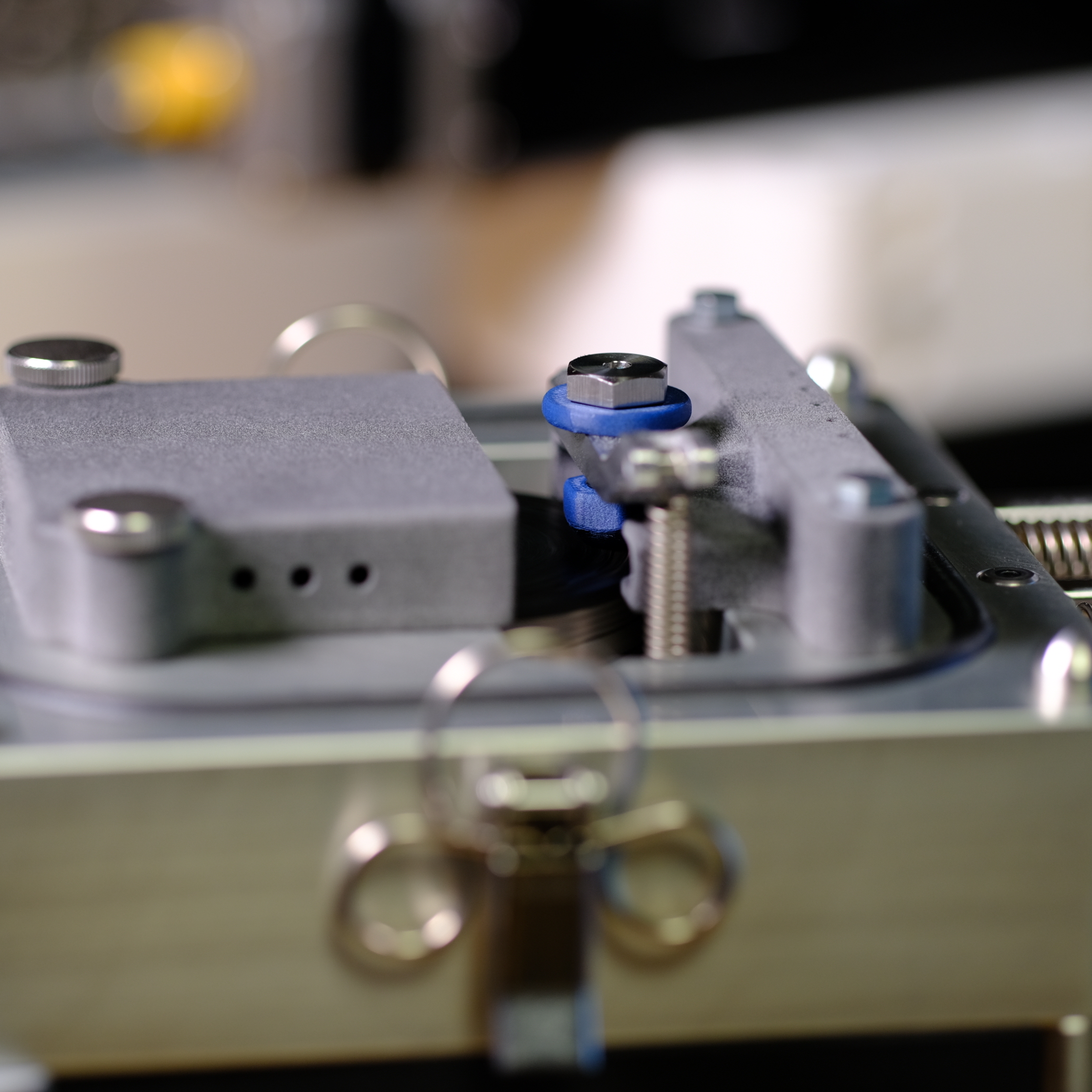
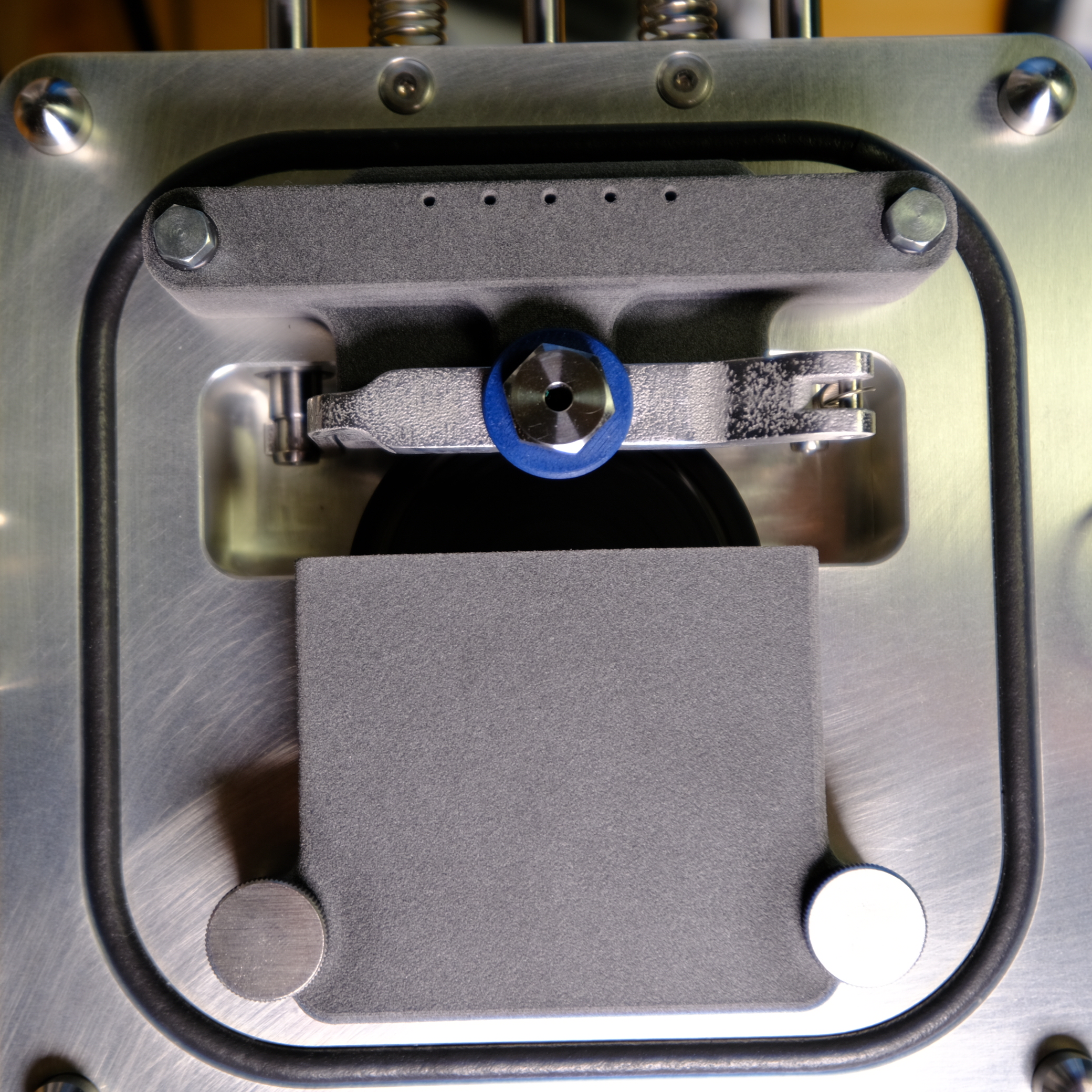
The system supports various contact geometries such as ball-on-disk and pin-on-disk under precisely adjustable loads, sliding speeds, and temperatures. At the same time, tribological parameters such as friction force, temperature, and motion characteristics are recorded at high sampling rates, enabling a detailed and reproducible analysis of tribological processes.
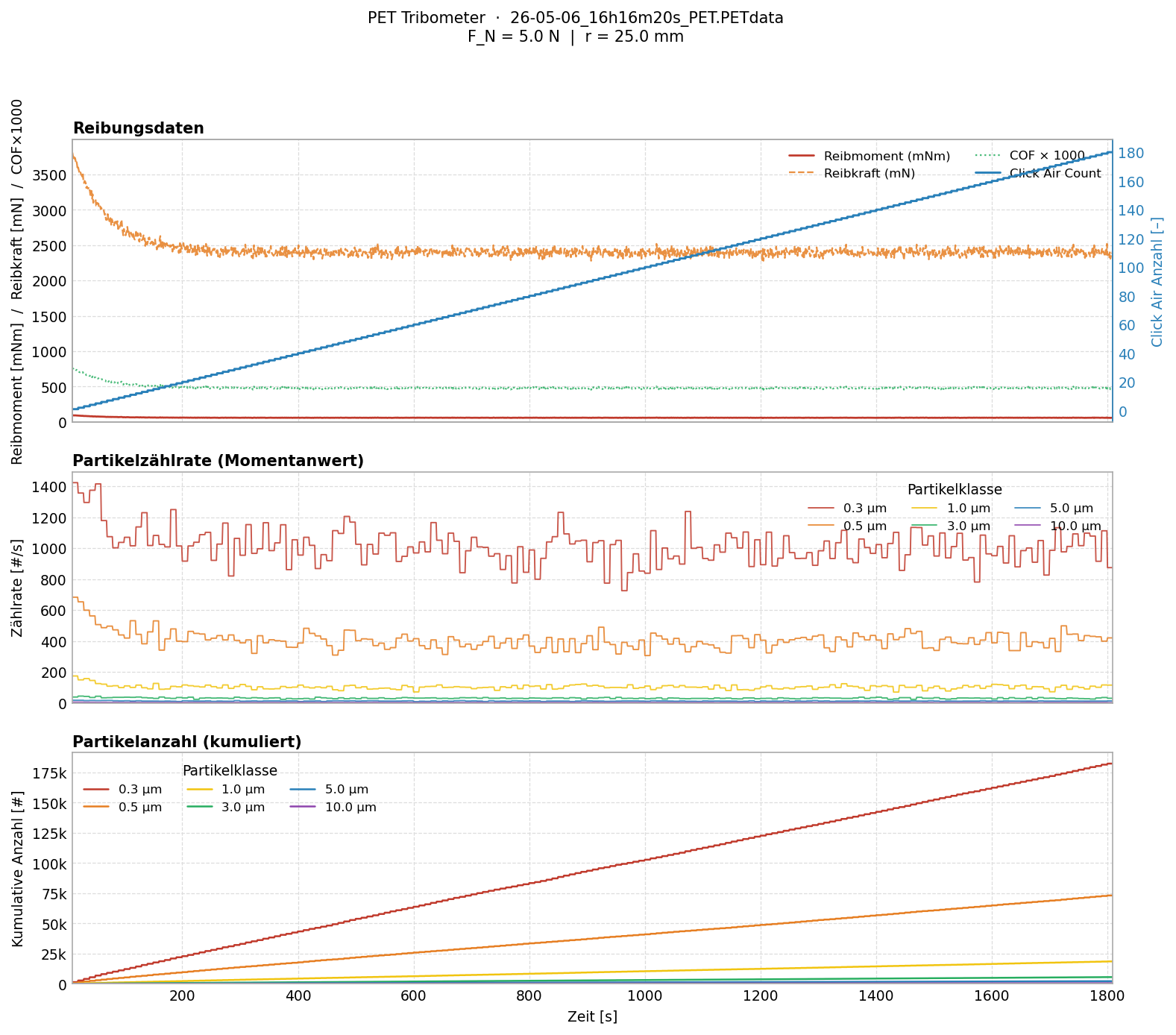
The figure shows data acquisition from the particle emission tribometer during a test at constant rotational speed. The top plot displays friction force, friction torque, and coefficient of friction (CoF) together with the recorded particle measurements. The middle plot shows particle counts per measurement interval, separated into particle size bins of the sensor used. A short running-in phase followed by relatively constant emission rates can be observed. The bottom plot presents the cumulative particle counts.
Applications in Cleanroom Technology, Materials Science, and Precision Engineering
The PET is particularly relevant for research and industrial applications in semiconductor manufacturing, pharmaceutical and biotechnology industries, medical technology, and high-precision mechanical engineering. It supports systematic material selection, qualification of cleanroom-compatible components, and validation of cleaning and surface treatment processes in accordance with standards such as ISO 14644 and VDI 2083.
Furthermore, the system can be used for quality assurance and failure analysis by identifying particle sources in tribological contacts. The practical application of such testing methods in industrial material selection for cleanroom environments is demonstrated, for example, by Materiales GmbH.
The PET enables an advanced understanding of wear mechanisms through time-resolved detection of particle emissions as a function of operating conditions. This allows clear differentiation between running-in phenomena, steady-state wear conditions, and transient effects. Materials with comparable friction coefficients often exhibit significantly different particle emission behavior, which cannot be captured using conventional tribological methods. The PET therefore represents a sensitive tool for evaluating material pairings, coatings, surface treatments, and solid lubricants with respect to their contamination behavior.